Hollywood Did More Damage to Bail Than Any Bill Ever Has
The short version
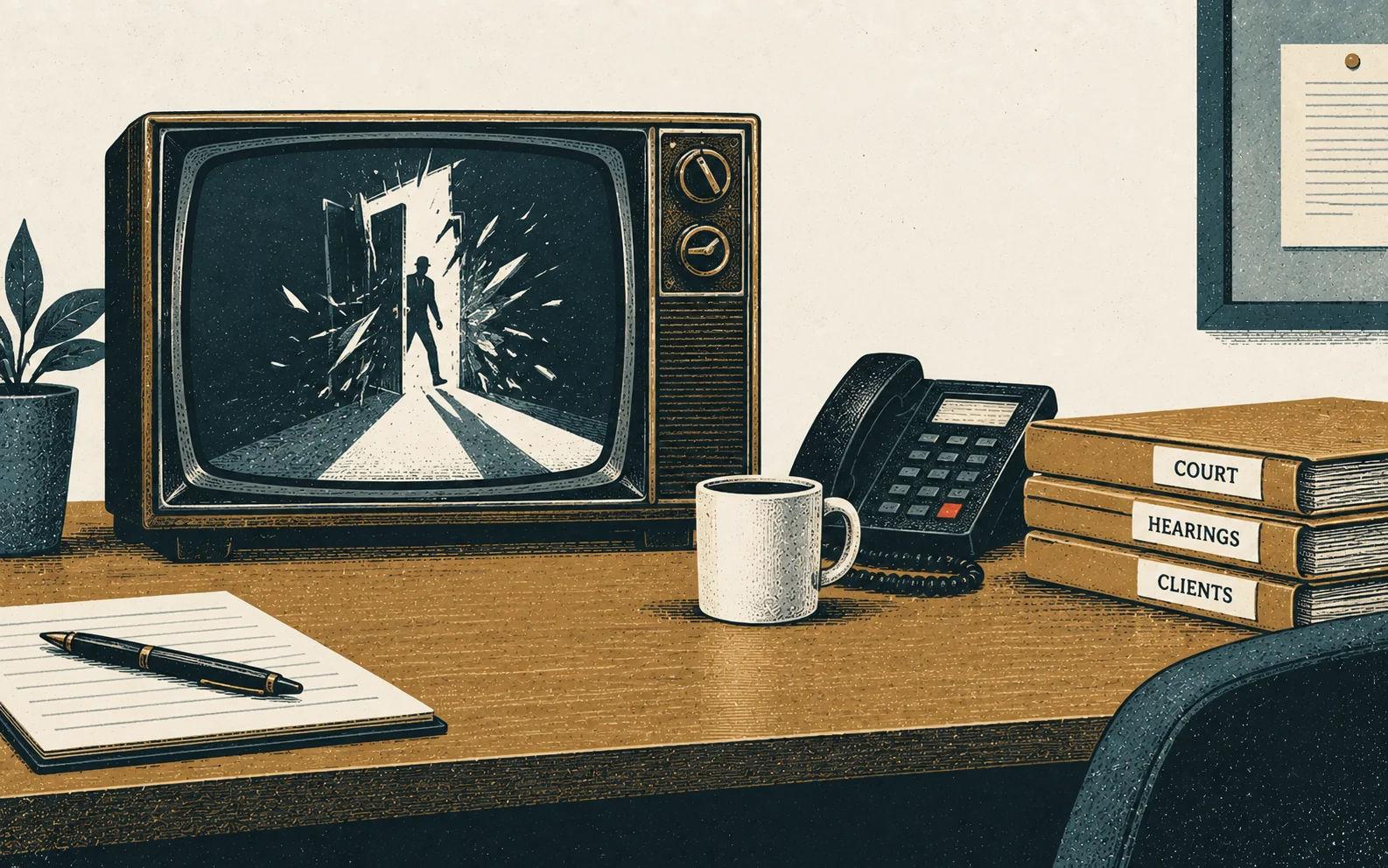
- Most people's picture of bail enforcement comes from television and film: chases, kicked-in doors and a camera crew.
- Lawyers, police officers and private investigators have all lived with a screen version of their job, and it has cost them in court, in public opinion and in recruiting.
- The real work, careful, lawful and mostly done by phone, is a better story, and the trade is the only one who can tell it.
If you have ever told a stranger what you do for a living, you know how the conversation goes. Their eyes light up, they ask whether you kick in doors, and somewhere in the next few minutes a movie or a TV show gets mentioned. You smile, because it is easier than explaining that most of your week involves phone calls, court records and paperwork, and that the best recovery you made this year ended with a mother driving her son to the courthouse.
That gap between the screen and the job is more than an irritation. It shapes how jurors, reporters, lawmakers and families think about everyone in this business, and over the years it has done the trade more lasting harm than any single bill.
Where does the picture come from?
For most people, not from the real thing. The average American has never posted a bond, never met a recovery agent and never sat through a bail hearing. What they know comes from decades of action movies built around the fugitive chase and, more recently, from reality television that follows the most dramatic moments of the job and leaves everything else on the cutting-room floor.
Drama needs conflict, so the screen version is all confrontation: the chase, the takedown, the shouting on the front lawn. The weeks of research, the calls to the indemnitor and the surrender arranged over the phone never make the edit, because nobody would sit through them.
Who else has been through this?
You are in good company. Plenty of professions have spent years explaining to the public that the job is not what they saw on television.
- Lawyers have courtroom dramas, where cases turn on a surprise witness in the final ten minutes. Real clients arrive expecting that, and a good deal of a defense attorney's time goes into explaining that most cases are resolved through paperwork and negotiation, not speeches.
- Police officers and crime labs have the forensic shows. Researchers funded by the National Institute of Justice surveyed more than a thousand jurors and found that many expected scientific evidence in every criminal case, a pattern the justice system has come to call the "CSI effect." Prosecutors now routinely address those expectations with juries.
- Private investigators have the trench coat and the car chase. The real work is database searches, court records and hours of patient observation, which is almost exactly what skip tracing looks like too.
- Repossession agents have reality shows built around confrontation, when the professional version of that job is designed to avoid confrontation altogether.
Each of those professions found that the screen version followed them into their clients' expectations, into the courtroom and into policy debates. Bail is no different.
46%
of more than 1,000 jurors in a survey funded by the National Institute of Justice expected scientific evidence in every criminal case.
What did the screen get wrong?
- The work itself. Most recoveries are resolved with a phone call, a family member bringing someone in or a quiet pickup. Skip tracing is research, not a pursuit.
- The authority. The screen suggests recovery agents can go anywhere and do anything. In reality there is a patchwork of state licensing, limits and outright bans, which we laid out in our guide to recovery authority by state.
- The people. On screen, the business is a cast of characters. In practice, it is licensed professionals running small businesses, answering the phone at night and filing paperwork by day.
Why does it still matter?
Because perception has a way of turning into policy. When a legislator pictures bail enforcement, they are rarely imagining an agent calling a family to arrange a surrender; they are imagining a raid. When an editor needs a photograph for a story about bail, it is seldom an office. Opponents of commercial bail have never had to invent a caricature of the industry, because the entertainment business built one for them and has kept it updated for decades.
It follows you into court as well. Jurors, judges and prosecutors watch the same television as everyone else.
1872
is the year of the Supreme Court case still cited for recovery authority. State laws have been narrowing that power ever since.
Did the screen do any good?
A little, and it is fair to say so. It made the work visible, it brought some good people into the trade, and it showed audiences that people who skip court do get found. Plenty of agents will tell you that the public at least takes a missed court date seriously now.
Visibility without accuracy is a mixed blessing, though. A profession that is famous only for its most dramatic moments ends up being judged by them.
What is the real job like?
Done well, it is careful and mostly unglamorous. You research before you make contact. You work the indemnitor before you knock on anything. You know the local rules, you coordinate with law enforcement, and you document everything, increasingly with a camera on your chest, as we covered in body cameras for recovery agents. Above all, you get a person back to court without anyone getting hurt.
That makes a better story than a door coming off its hinges. It just has not been filmed yet.
How does the trade fight back?
The other professions offer a clue. Lawyers and prosecutors did not fix the screen version by complaining about it; they got better at explaining the real thing to the people in front of them. The bail trade can do the same: tell families how the process actually works, share the court reminder that kept a client out of trouble and the surrender that ended with a handshake, and put working professionals rather than caricatures in front of legislators.
The trade does not need its own show. It needs a thousand small, true stories told by the people doing this work well, and those people already have them.
Final thoughts
Every recovery agent has had that conversation at a barbecue, and most of us gave up correcting it years ago. That is a mistake. The screen version of this job is the only version most people will ever see, unless we show them the real one.
Other professions learned that the fix is not arguing with Hollywood, it is explaining your own work better than the movies do. The best recoveries are the ones nobody would ever think to film, and that is exactly the point worth making. Recovery laws vary by state, so know yours before you act.
Field Correspondent
READ MORE
When the Cosigner Goes Quiet: Working Indemnitors in a Recovery
by Marcus Hale · October 6, 2026

Body Cameras for Recovery Agents: Liability Insurance You Wear
by Marcus Hale · June 15, 2026
The Surrender Option: Getting Off a Bond Before It Forfeits
by Marcus Hale · June 14, 2026