You Can't Advertise on Google. Plan as if You Never Will.
The short version
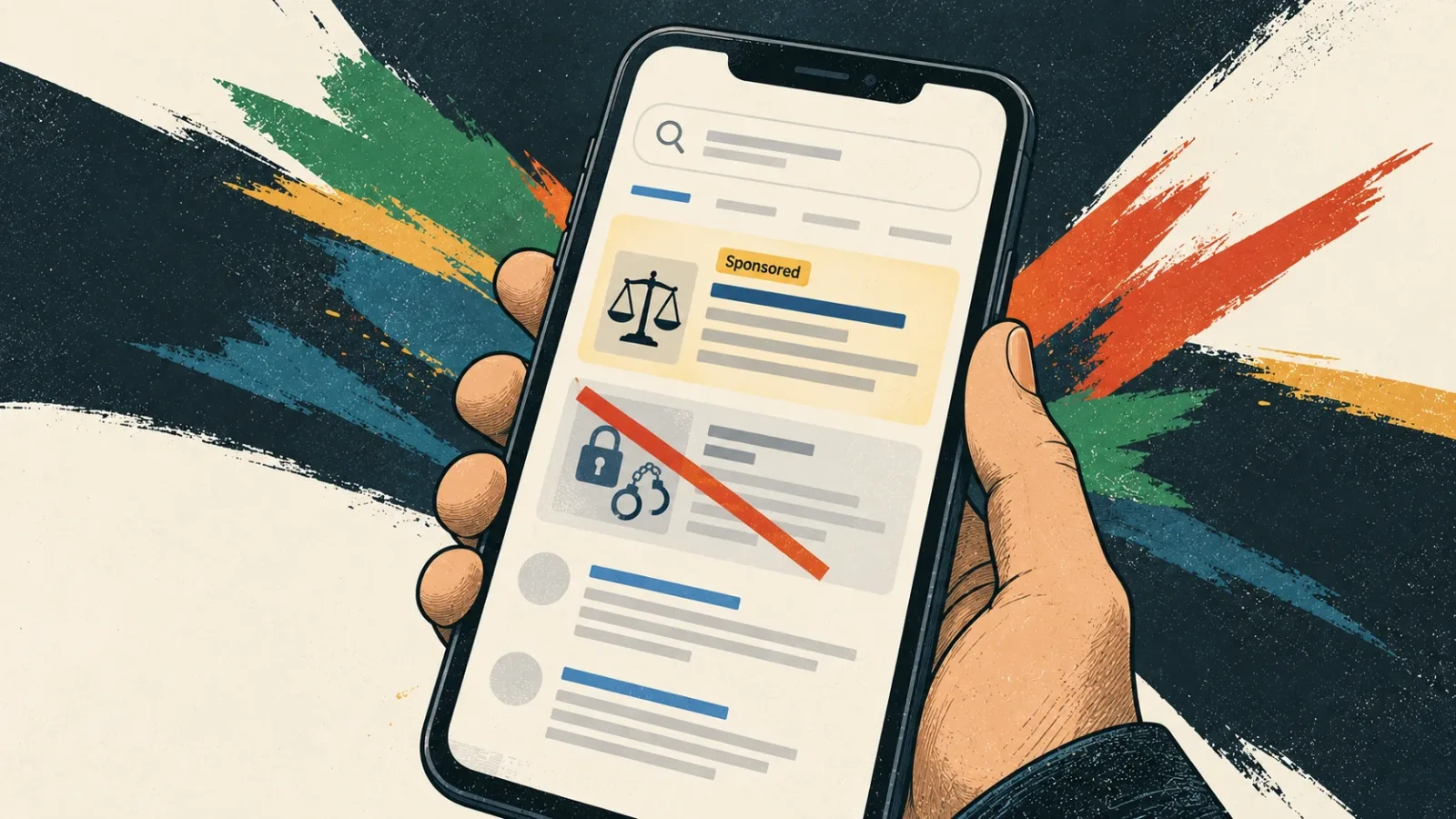
- Google, where about 85 percent of US searches happen, has banned bail bond ads worldwide since July 2018. Meta lists bail bonds as a prohibited ad product, and TikTok lists them as not allowed in the United States and Canada. Boosting a Facebook or Instagram post is buying an ad, so Meta's ban covers it too.
- The defense lawyer on the same case can still buy the click. Google left legal services out of its ban.
- Gambling and crypto can get back onto Google with a license and Google's certification, and lenders can if their loans meet Google's terms. Bail has no way back, and eight years in there is no sign of one.
- What is left is free and local: your Google Business Profile in Maps, your reviews, and showing up for the exact words families type at two in the morning.
In May 2018, Google posted a short notice on its advertising policy pages. It would change its rules to prohibit advertising for bail bond services, worldwide. In July 2018 it did. Its examples of what the ban covers: bail bond agents, bounty hunters and bail bondsmen, and bail bond financing. Its current bail page adds immigration bail and detention bail services, which matters if you write immigration bonds.
That is a big door to lose. Google handled about 85 percent of searches in the United States in September 2026, according to StatCounter. Bing, the next biggest, handled about 10 percent.
85%
of searches in the United States went through Google in September 2026. Bail cannot buy a single ad there.
Not restricted. Banned. Plenty of industries can still buy Google ads if they get certified or meet extra conditions. Bail is not one of them. Google's policy page today still says plainly that promoting bail bond services that act as surety for a defendant is not allowed.
Why 2018: bail got the payday-loan treatment
The bail ban did not come out of nowhere. In May 2016 the same Google executive, David Graff, its director of global product policy, announced a ban on ads for payday loans and related products: loans due within 60 days and, in the United States, loans with an APR of 36 percent or higher. He said that change was designed to protect users from "deceptive or harmful financial products."
36%
The APR line Google drew for loan ads in 2016. Lenders under it can still advertise. Bail got no line at all.
Two years later his bail announcement used almost the same words, "deceptive or harmful products," pointed to studies about who pays for bail, and singled out "opaque financing offers that can keep people in debt for months or years." He also wrote that changing the bail system had support from groups as far apart as Color of Change and Koch Industries. Google treated bail the way it had treated payday lending.
It is not only Google
Meta goes further. Its advertising standards, which cover Facebook and Instagram, list bail bonds among prohibited loan products, next to payday loans, paycheck advances and short-term loans of 90 days or less. Here is how they describe it:
Bail Bonds, which are loans that allow criminal defendants to get conditional release from custody
That is not how a bail bond works. The premium buys a surety's promise to the court. Nobody borrows the bail. But it is how the ban is written, and it applies to the boost button too: a boosted post is an ad you pay Meta to run.
TikTok's financial services ad policy lists bail bonds among its examples of what is not allowed for the United States and Canada. Three of the biggest places a small business can buy attention all say no.
The lawyer on the same case can still buy the click
One line in Google's announcement matters more than the rest: advertising for legal services or legal representation would not be affected.
So when someone is booked tonight and a family member searches for help, the defense attorney can pay to sit at the top of the page. The agent who can post the bond cannot. Two businesses working the same arrest, and only one of them is allowed to raise its hand.
How other industries got back in
Bail is not the only trade Google has squeezed. The difference is that others were given a way back.
- Gambling. Online casinos, sportsbooks and state lotteries can advertise on Google once it certifies them. Each needs a state license, or must be the state lottery itself, and no ad may target anyone under 21.
- Lenders. The 2016 rules still stand, but a lender whose personal loans run 61 days or longer at under 36 percent APR can buy ads.
- Crypto. Google banned cryptocurrency ads in June 2018, a month before bail. Today exchanges and wallets targeting the United States can advertise if they are registered with FinCEN as a money services business and with at least one state as a money transmitter, and certified by Google.
Pawn never needed a way back, because neither Google's financial services policy nor Meta's prohibited loan list names pawnshops. Both write their lending rules by the length of the loan instead: Google allows personal loan ads only for loans of 61 days or longer, and Meta bans loans of 90 days or less. A short pawn loan may well fall foul of both.
Gambling and crypto got in through the same gate: a license from a regulator that Google can check, plus Google's own certification. Lenders got in by meeting Google's terms on the loan. Bail agents are licensed too. There is no gate for them.
Will Google ever change back?
Nobody outside Google can say, and the signs point the other way. The ban is eight years old, and Google's current bail page names more services than the 2018 notice did.
If bail ever gets a path, it will most likely look like the one gambling and crypto have: certification for licensed agents and sureties. It would likely take the trade asking for it. Until then, plan as if the door stays shut.
8 years
since Google's bail ban took effect in July 2018. In that time its bail page has added services to the list, not taken any off.
What families actually type
Google's search suggestions reflect real searches, so they show the words people use. Type the trade's own terms into Google from the United States and this is what it offers, as of October 2026 (suggestions vary by place and by your own past searches, so yours may differ):
- bail bonds near me, and bail bonds near me open now
- bondsman near me within 5 mi
- bail bonds near me with payment plans, and bondsman near me that take payments
- bail bonds near a named jail, such as Bexar County jail or Gwinnett County jail
- 24 hour bail bonds near me
- bail bonds plus a city: Dallas, Houston, San Antonio, Las Vegas
Notice what is missing. Type "bail agent" and Google suggests license lookups, jobs and salaries: the trade looking at itself, not a family looking for help. The customer types "bail bonds" or "bondsman," a place, and often "open now" or "payments."
How the map at the top decides
With no bail ads allowed, searches like these usually open on a map with a short list of local businesses under it. Google says that list is mainly based on three things: relevance, how well your profile matches the search; distance, how far you are from the person searching; and prominence, how well known you are, which includes how many websites link to you and how many reviews you have. It also says there is no way to pay for a better local ranking.
For a bail agency that comes down to a short list:
- Claim and verify your Google Business Profile. Google says verified businesses are more likely to show up.
- Set your hours. Google asks for your real customer-facing hours. If a family can reach you and get a bond started at any hour, your profile should say open 24 hours. Searches that end in "open now" lean on those hours.
- Say it in the words families use. Payment plans, the jails you post at, the cities you cover, in your description, services and service area. Keep your business name exactly as it appears on your sign: Google can suspend a profile for adding extra words to the name. Relevance is matching what people type.
- Ask for reviews and answer them. Google names review count and ratings as part of prominence. Never offer a discount or anything else in return for a review: Google bans incentivized reviews.
- Get listed where it counts. Links from other websites feed prominence too, including directories like this one.
Distance you cannot change: it is measured from the person searching. Everything else on that list is free.
Where do your clients come from now?
With paid search closed, every agency has worked out its own mix. We want the real numbers.
Think about your last ten clients. Where did each one come from? Repeat family, word of mouth, Google Maps, a lawyer, something else? Write to us at info@bailwatcher.com. We will add up the answers and publish what the trade actually runs on, without names.
Sources: Google Ads Help, "Other restricted businesses: Bail bonds (May 2018)", "Update to Other restricted businesses policy (July 2018)" and the current "Other restricted businesses" and "Bail bond services" policies; David Graff, "Google bans ads for bail bonds services", Google blog, May 7, 2018, and "An update to our AdWords policy on lending products", Google public policy blog, May 11, 2016; Google Ads Help, "Gambling and games", "Financial products and services", "Financial Services: New restricted financial products policy (June 2018)", "Update to Financial products and services policy (June 2021)" and "Cryptocurrencies and related products"; StatCounter Global Stats, search engine market share, United States, September 2026; Meta Transparency Center, advertising standards, "Financial and insurance products and services"; TikTok Ads Help, "Financial Services" policy; Google Business Profile Help, "Tips to improve your local ranking on Google" and "Guidelines for representing your business on Google"; Google Maps user contributed content policy, "Fake engagement"; Google Search Help, "How Google autocomplete predictions work"; Google search suggestions checked from the United States on October 19, 2026. Policy pages read on October 19, 2026.
Final thoughts
For agency owners: the paid-search door closed in 2018 and has stayed shut. Your profile, your reviews and the words families use are the part you control. Tell us what is bringing your clients in.
Markets and Surety
READ MORE
California Lost 900 Bail Licenses. Did Anyone Notice?
by Wade Caldwell · October 15, 2026
What a Bail Bond Costs, With Real Numbers
by Wade Caldwell · October 10, 2026
The Scam Calling Your Clients' Families Before You Do
by Dana Whitfield · July 15, 2026