California Makes Posing as a Bail Agent a Crime. Hiring One Counts Too.
The short version
- From January 1, 2027, California adds a specific crime for posing as a licensed bail agent while soliciting bail (unlicensed soliciting was already illegal). It is also a crime to hire a person or company to solicit bail when you knew or should have known they were posing as one.
- "Solicit" covers phone calls, robocalls, texts, emails and in-person contact. The penalty is the bail code's: a fine of up to $10,000, up to a year in county jail or a felony term, or both.
- Bail agents pushed for it. Their complaint: cold callers using scraped booking data and data brokers to reach families within minutes of an arrest, quoting illegal cut rates, some of them not licensed at all.
- The bill began as a ban on unrequested calls to arrestees' families, with civil fines and private lawsuits. The final law is narrower: a licensed agent may still call an adult family member without a prior request, within the existing hours.
- Texas, Florida, North Carolina and Minnesota already police unlicensed or late-night solicitation, but none of the four uses a "should have known" standard for whoever hires a fake agent; Florida requires "knowingly." A Florida bill this year copied California's solicitation rule almost word for word as filed; a Senate committee cut that part in February.
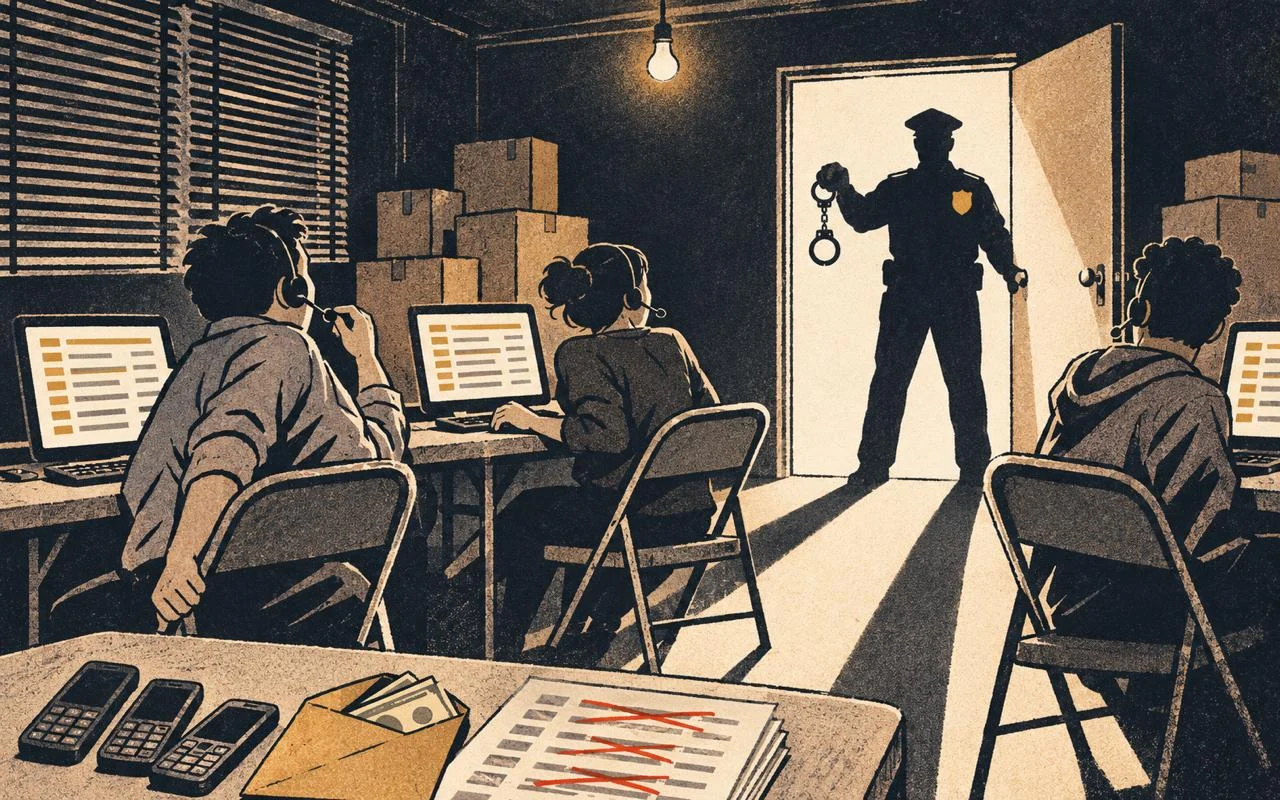
A family gets a call minutes after an arrest. The caller says they are a bail agent and can get their son out tonight. In California, an unlicensed caller is already breaking the law. From January 1, if you paid for that call, the crime may be yours too.
What changes on January 1
Assembly Bill 1927, the Bail Consumer Protection Act, adds section 538j to the Penal Code. The governor signed it on September 30 as Chapter 908. It has no urgency clause, so it takes effect on January 1, 2027. It covers two people:
- The impersonator: anyone who "impersonates, or falsely holds themselves out to be, a licensed bail agent" and, while doing so, solicits or tries to solicit bail.
- Whoever hires them: anyone who hires another person or company to solicit bail "when the person knew or should have known" that the other person or company was posing as a licensed bail agent, and that person or company then solicits or tries to.
Both face the penalties in Insurance Code section 1814: a fine of up to $10,000, up to a year in county jail or a felony term, or both. The new section says its penalties add to any other law, including theft charges and the bail licensing rules.
The words that matter: "should have known"
The second offense is the one licensed agencies should read twice. It does not require proof that you knew. If a lead vendor, call center or text service calls families for you, and its callers present themselves as licensed bail agents when they are not, a prosecutor can argue you should have known.
California already required a license to solicit bail. Insurance Code section 1800 says a person "shall not in this state solicit" bail unless licensed, and it counts phone and other presentations that imply a license, and any paid activity in arranging bail. What is new is a crime aimed squarely at the agency that pays for the calls.
What did not change
The bill started much broader. The version that passed the Assembly in May targeted unrequested calls, texts and emails to an arrestee's family and known contacts, by agents and impersonators alike. It carried civil penalties of $1,000 to $5,000 per solicitation, $5,000 to $10,000 for repeat violations, enforcement by the Attorney General and a right for families to sue. The Senate Public Safety Committee's analysis noted that this would have replaced regulations carrying criminal penalties with smaller civil fines, and the Assembly Appropriations Committee put the Justice Department's enforcement cost at about $600,000 a year. By the time it passed, the bill was down to the two offenses above.
So California's existing solicitation rules still apply, unchanged. Under Title 10 of the California Code of Regulations:
- No soliciting inside a jail, court or the halls next to them, though where local rules allow you may transact bail in those halls with a person listed in section 2079 who has already asked for you (section 2074).
- No arrangement with anyone, from jail inmates to officers, to tip you off about arrests (section 2076). The California Supreme Court upheld that rule in 2023 in People v. Martinez.
- You may solicit only the arrestee, the arrestee's lawyer, an adult member of the immediate family, or someone the arrestee names in writing (section 2079).
- Soliciting the arrestee needs a bona fide request first, from the arrestee, the lawyer or an adult family member. Soliciting family members or designated people, by any means, is limited to 7 a.m. to 11 p.m. unless the arrestee or the lawyer authorizes another time in writing; no prior request is required for them (section 2079.1).
That leaves the cold call that started the bill where it was. A licensed agent may still call an adult member of an arrestee's immediate family between 7 a.m. and 11 p.m. without a prior request, as long as the tip about the arrest did not come through an arrangement section 2076 bans. What changes on January 1 is the caller who claims a license they do not hold, and the agency that hires them.
Why the bail agents asked for it
The California Bail Agents Association was the bill's source. The committee record describes three problems, and names no company, case or complaint count.
- Cold calls built on scraped data. The National Association of Bail Agents, writing in support, said that "using automated scraping software, bad actors harvest real-time booking data, trace family members through commercial data broker services, and place unsolicited calls," sometimes within minutes of an arrest.
- Cut-rate quotes. Cold callers "frequently lure families with illegal below-rate premiums, then layer hidden fees," NABA wrote, adding that agents who follow the rules cannot match the discounts.
- Fake agents. The same public booking data is open to people posing as agents, "enabling outright fraud targeting families in crisis." The March version also covered anyone posing as a law enforcement agency to sell bail.
The author, Assemblymember Maggy Krell, said "both licensed bail agents and unlicensed scammers" were soliciting illegally, and that families had no explicit remedy under the existing rules. NABA argued those rules do not explicitly reach automated scraping followed by data-broker lookups of family members.
The coalition was unusual. For the March version, the Assembly Public Safety Committee listed the sponsor, the Golden State Bail Agents Association, NABA, two sureties and 23 bail companies as supporters, alongside the California Public Defenders Association, Consumer Attorneys of California and Crime Victims United. No one opposed it. It passed the Senate 40 to 0 and the Assembly 79 to 0 on final concurrence.
Would this work in your state?
Every state we checked already requires a license to sell bail. What we did not find in the four states below is California's new pairing: a crime aimed at impersonators who call, text and email, and at whoever hires them on a "should have known" standard.
- Texas: a surety, an agent or their employee "may not make, cause to be made, or benefit from" unsolicited in-person or phone contact to solicit bail between 9 p.m. and 9 a.m. (Occupations Code 1704.109). "Cause to be made" and "benefit from" reach an agency whose vendor makes the late call. Taking money for referring bail business is a Class A misdemeanor unless the bail bond board's records show you are the license holder's agent or employee (1704.302). The chapter applies in counties of 110,000 or more and in smaller counties that create a board. The same section also bars calls within 24 hours of an arrest and contact about unserved warrants, but in 2007 a federal appeals court held both unconstitutional in a case against Harris County and its bail bond board, while upholding the overnight ban (Pruett v. Harris County Bail Bond Board).
- Florida: acting as a bail bond agent without a license is a third-degree felony, and so is a licensee who "knowingly aids or abets an unlicensed person" (Statutes 648.30). No in-person or phone solicitation at the detainee's or the family's home after 9 p.m. or before 8 a.m. (648.44). Florida's test for the agency is "knowingly." California's "should have known" is a lower bar, though it applies only when the hired caller poses as licensed.
- North Carolina: no one may act as a bondsman or runner without a license (G.S. 58-71-40). A runner works for one professional bondsman, who supervises the runner and is "responsible for the runner's conduct in the bail bond business" (58-71-65). Soliciting in the courts, magistrates' offices or where prisoners are held is banned (58-71-95).
- Minnesota: on calls, Minnesota already goes further than California's final law. A 2024 law bars producers from "unauthorized and unsolicited cold calls without having first spoken with the principal," and bars sureties, agencies and producers from paying anyone not licensed as a producer for selling or soliciting a bond (Statutes 60M.05 and 60M.06).
We could not open the official text of Georgia's or Tennessee's code in time for this story, so they are not in this list.
Will other states follow California?
California's bail laws do not always last even at home: in 2020 voters rejected Proposition 25, the referendum on the 2018 law that would have ended money bail, 56.4 percent to 43.6 percent.
On solicitation, though, California's approach has already been tried elsewhere. Florida's Senate Bill 600 this year, as filed, copied the wording of California's who-and-when rule almost word for word, with Florida hours of 8 a.m. to 9 p.m. A Senate committee stripped that language in February. The rest of the bill passed the Senate and died in the House in March.
Our read: the impersonation offense is the part most likely to spread. It is the easy case in law. In the Texas case, the federal appeals court noted that government "may ban misleading commercial speech," and a caller falsely claiming a license is exactly that. Limits on truthful calls face a harder test: Texas lost its 24-hour and unserved-warrant limits for lack of evidence they worked, and kept only the overnight ban. Watch for bail associations in other states to bring California's text to their next session.
What to do before January 1
- List everyone who contacts families for you: staff, lead sellers, call centers, text and robocall services.
- For each, get the license number of every person who speaks or writes to families, and check it with your state's bail licensing regulator (in Texas, the county bail bond board).
- Read their scripts. In California, anyone who solicits for you must hold a bail license, whatever the script says (Insurance Code 1800).
- Put it in writing: the vendor's contract should say its callers are licensed and follow your state's solicitation rules, and let you end the deal if they do not.
- Keep the records. If a family complains, your file is your answer to "should have known."
Your turn
Have families told you about a caller who claimed to be a bail agent and was not? Write to us at info@bailwatcher.com. We will share what agents tell us, without names.
Sources: California Assembly Bill 1927 (2026), Chapter 908, chaptered text, and votes, California Legislative Information; Assembly Committee on Public Safety analysis (hearing March 24, 2026), Assembly Floor Analysis (May 20, 2026), Senate Committee on Public Safety analysis (hearing June 23, 2026) and Senate Floor Analysis (August 2026); California Penal Code 538j; Insurance Code 1800 and 1814; California Code of Regulations, title 10, sections 2074, 2076, 2079 and 2079.1, as reproduced in the California Department of Insurance notice "Reminder of Bail Solicitation Laws," September 21, 2023. Texas Occupations Code 1704.002, 1704.109 and 1704.302; Pruett v. Harris County Bail Bond Board, No. 05-20714 (5th Cir. June 7, 2007); Florida Statutes 648.30 and 648.44 (2026); Florida Senate Bill 600 (2026), as filed, and its bill history; North Carolina General Statutes 58-71-40, 58-71-65 and 58-71-95; Minnesota Statutes 60M.05 and 60M.06; California Secretary of State, Supplement to the Statement of Vote, November 3, 2020. All read from the source on November 18, 2026.
This article is general information, not legal advice. Solicitation rules differ by state; confirm yours with your state's bail licensing regulator (in Texas, the county bail bond board). Spotted an error? Write to info@bailwatcher.com and we will correct it.
Final thoughts
For agency owners: list everyone who calls or texts families for you, check every license, read the scripts and put it in the vendor contract before January 1. Outside California, check your own state's solicitation rules before a similar bill reaches your legislature.
Markets and Surety
READ MORE
North Carolina's New Address Form: What to Do When a Client Moves
by Wade Caldwell · November 18, 2026
Bail Bonds in Wyoming: How It Works, Costs, and What to Know
by Dana Whitfield · November 9, 2026
Bail Bonds in Washington State: Costs, Process, and What to Know
by Dana Whitfield · November 6, 2026